Appraisal Articles 2019 Free Appraisal Articles for Appraisers and the Public
Top Categories
- General Appraisal — 180
- Property Appraisal — 105
- Real Estate — 98
- General Property — 87
- Narrative Writing — 21
- Litigation / Expert — 12
- Technology — 10
- Appraisal Software — 6
- Writing Appraisal Articles — 5
- Business Appraisal — 4
- Healthcare Facility — 4
- Estate and Probate Appraisals — 3
Articles Archive
Latest News
Note about "Views" reported on this site
Feb 7, 2014
I just want readers, contributors and potential contributors to realize that the...
This Site is Monitored
Dec 28, 2013
Articles that are not deemed contributory are removed from this site promptly, so we would...
New Site Template
Nov 30, 2013
Please pardon our somewhat painful transition, we have been working with Subrion.com...
Appraising Water Treatment Plants and Power Generating Facilities
by Administrator on May 25, 2016 • Public / Private Utility Appraisals • 1766 Views
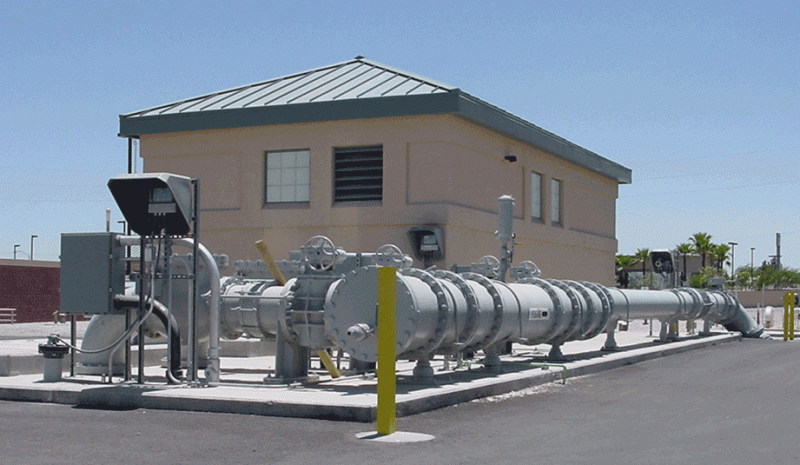
Many appraisers are never given the opportunity to appraise a water treatment plant or a power generating facility since many are publicly owned and they don't often transfer ownership but there are times when even the government or a private utility owner need a property valuation.
Water treatment plants and power generating facilities are "going-concerns,' and thus the properties include a real property value and a value associated with their business entity, but the business entity value is usually nominal. Properties of this type are capital intensive and rates are often regulated. Does that mean that these facilities don't provide good returns? No. As evidenced by the recent acquisitions of major utility companies by prominent investors it is anticipated that utility companies currently provide and will likely in the future provide a reasonable return.
Sales Approach: sales approach comparisons are usually made between water treatment plant sales or power generating facility sales and a subject property based on a price per dwelling unit served, price per gallons per day, price per KW generated or a price per service connection unit of comparison.
In 2015 / 2016 there is evidence that more public utilities are selling facilities and many private buyers have profit expectations that are inconsistent with the original intent of the public who allowed public funding for the facilities. Appraisers must consider the fact that the rates that exist prior to the sale of a publically held utility may not be the rates anticipated in the future by the private sector buyer. It is likely that the Sales Comparison Approach and the Income Approach will be given more weight in the future since public sector sellers will expect to garner a portion of the anticipated / increased future income stream.
Income Approach: historical income and expense information is evaluated by appraisers as part of the appraisal process. Capitalization rates for utility properties are well established as are expense profiles. Projected earnings from water treatment plants and water treatment facilities are discounted using a discounted cash flow (DCF) analysis in much the same way as is applied to small-scale commercial properties with consideration given to anticipated rate increases. Selecting a discount rate and residual capitalization rate is difficult but can be reasonably derived. A present value model considers the cash flow generated by a facility over time and the discount rate considers the risk associated with receiving the income.
Obviously you often cannot use revenue data from a publically owned water treatment plant or a publically owned power generating facility to discover its market value since they are held as non-profit entities by government or quasi-government organizations. The volume of service information available is however valuable since it is not that difficult to impute market rates that are being charged by private for profit facilities. Expense information is also valuable since the expenses reported for a publically owned facility can be compared to the expense profiles reported for privately owned facilities.
There is of course a significant and reasonable resistance to making public income and expense comparisons to private income and expense reports and thus the income approach is thus not as valuable as it would be in other circumstances.
Cost Approach: there is usually cost / asset data available to appraisers for analysis on these complex property types and together with the value of the underlying land the depreciated value of a facility can be estimated. I'm not saying developing a cost approach on properties of this type is easy, in fact it's quite arduous especially if you haven't appraised properties of like this type before. The total cost of the assets less depreciation provides a "net book value." This cost based value is often relied upon by buyers and sellers when a small premium adjustment is made.
As an appraiser you will find that normally reliable sources of appraisal data like the Marshall Valuation Service has relatively little data to help you with the appraisal of water treatment and power generating facilities. There are costs per square foot provided for different sized water treatment plants based on their gallons per day capacity but nothing that provides the detail that you will need to complete an appraisal assignment. Generating plant costs are similarly presented in an aggregate per KW way with costs provided by fuel type (i.e. cool water gasified, fossil fuel, geothermal, hydropower, natural gas and nuclear). These costs can help give you a broad range by type but developing a cost approach for an appraisal report will take considerably more effort.
The Cost Approach has often been favored by buyers and sellers of these large-scale facilities and, as is typical using the approach, facilities that are new or nearly new are going to be the most reliable. Applying depreciation applied is subjectively applied.
The value of a public utility when purchased by a private company increases and in my opinion the public owner / seller should be compensated for the fact that the rates will be increased. Once the private owner gets rate increases the value of the facility effectively increases and they can sell for a profit. Why shouldn’t a public owner benefit from the anticipated cash flow and residual property value increases that will in almost all cases occur?
For more appraisal information contact Glenn J. Rigdon MA, MRICS, ASA is a Las Vegas / Henderson Nevada based appraiser who can be contacted via email or via his business website known as Appraiser Las Vegas (http://www.appraiserlasvegas.com), or you can also click on “Contact Us” on the home page of this website or visit my public profile at LinkedIn at http://www.linkedin.com/pub/glenn-rigdon-ma-mrics-asa/1a/30b/879/
Article source: http://www.appraisalarticles.com/Public-Private-Utility-Appraisals/4617-Appraising-Water-Treatment-Plants-and-Power-Generating-Facilities.html
Author

Administrator
• Articles: 339 • Contact author
Random Articles
Sister Website for Sale
Aug 3, 2016 • 637 Views
Contract For Deed Offers Unique Way to Buy Real Estate
Jul 28, 2012 • 2005 Views
Appraising Residential Subdivision Sites
Mar 16, 2012 • 2243 Views
Multi-Family Appraisal Reports
Nov 25, 2015 • 2911 Views
Most Recent Articles
Actions
Popular Articles
Cell Tower Site Appraisals
11235 Views
Tax Deductions / Tips for Real Estate Appraisers
11164 Views

Advertisement